The Coordination Gap
Walk into any company that deployed AI tools in the last year. The C-suite sent the memo six months ago: productivity gains expected, adoption mandatory. The AI team built the platforms, configured the agents, ran the training sessions, wrote the documentation. Everything is ready. Now look at the floor.
200 AI applications available across the enterprise. Average employee proficiency with them: 28%. Not 28% of the tools. 28% of the employees know how to use any of them at all. WalkMe's 2025 enterprise survey found that number and it explains everything that follows.
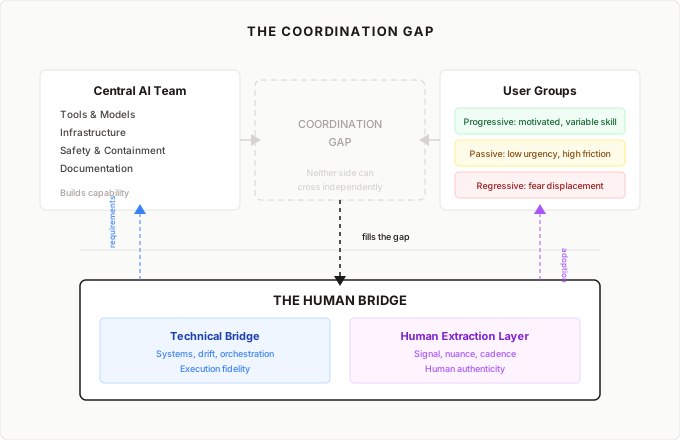
The structural problem is not motivation. It is architecture. Central AI teams build tools from a systems perspective. They optimize for capability, coverage, deployment speed. User groups experience those tools from a workflow perspective. They need the tool to fit into how they already work, not the other way around. These two perspectives do not naturally align. And nobody in the current organizational chart is responsible for making them align.
McKinsey's 2025 survey found 88% of organizations use AI in at least one business function. Six percent qualify as high performers generating meaningful impact. 84% have not redesigned a single role around AI capabilities. The tools are deployed. The humans have not caught up. And the gap between those two states is where most of the promised value is evaporating.
The user groups that encounter this gap split along behavioral lines that any deployment team recognizes immediately:
- Progressive users want to adopt. They are motivated but their skill levels vary wildly. Some are building real workflows. Others are enthusiastic but producing hallucinated output they do not know how to verify. Motivation without competence creates its own category of risk.
- Passive users are not resistant. They are indifferent. Moderate friction, low urgency. They will use AI if someone sets it up for them and the activation energy is near zero. They will not seek it out. They represent the bulk of most organizations.
- Regressive users fear displacement. They perceive AI adoption as a direct threat to their role and respond by slowing down, questioning outputs more than necessary, or quietly refusing to engage. This is not irrational. For some of them, it is correct.
Central AI teams cannot solve this. They can build better tools, write better documentation, run more training sessions. None of that addresses the structural misalignment between how the tools work and how humans work. User groups cannot solve it either. They do not understand the systems deeply enough to bridge the gap independently, and when they try, the result is misuse, not adoption.
This structural tension, AI capability on one side, human organizational reality on the other, with no native connection between them, is what creates the coordination gap. The role that fills it does not exist in any standard org chart. It is emerging from pressure, not from planning.
The Technical Bridge
Picture someone running 20 AI agents in parallel across a product build. The agents are fast. They are executing. Code is being written, tests are running, documentation is being generated. Everything looks green. Then one agent silently drifts from the original specification. It is still producing output, still technically running, but the output has diverged from the intent in ways that will not surface until integration. Another agent hits a sandbox limitation that nobody documented. A third generates a compliance violation embedded in otherwise correct code, because it never saw the policy document that prohibits certain data handling patterns.
Nobody on the AI team sees this. They built the platform. It is working as designed. Nobody on the business team sees it either. They requested a feature and output is appearing. The divergence is invisible to both sides until it compounds into a failure that is expensive to unwind.
This is where the Technical Bridge operates. Not building the AI systems. Not using them as an end user. Sitting at the intersection, managing the space between what AI systems are capable of and what the organization actually needs them to do.
The Future of PM described the shift from managing people to managing agent swarms, and identified context as the critical bottleneck. The Technical Bridge is the role that makes that shift operationally real. When Carlini ran 16 parallel Claudes to build a C compiler, the biggest challenge was not the code. It was keeping agents from colliding. When Zach Wills managed 20 agents for a week, his top insight was that long runtimes are red flags, meaning an agent has hit its context limit and is slowly forgetting the original goal. Those are coordination problems, not capability problems. And they require a specific kind of person to manage them.
The Technical Bridge understands AI systems deeply enough to manage drift and containment risk. They know why sandboxing constraints exist and why output variance is non-trivial. They can coordinate multiple terminals, contexts, and parallel workflows simultaneously. They translate business requirements into structured AI execution. They detect where AI breaks operationally and feed those insights back to the central AI team in a language the AI team can act on.
This is not a pure engineer. Not a pure PM. Not a pure strategist. It is someone who operates at the intersection of all three, managing the orchestration layer between what the system does and what the organization needs it to do.
Eightfold AI called this the most important job of 2026. Their data shows organizations with orchestration specialists achieve full agent productivity 65% faster and report 3x higher employee satisfaction with AI tools. Microsoft's 2025 Work Trend Index found 82% of executives expect AI agents in their workforce within 18 months. Only 23% feel confident about effective integration. The gap between those two numbers is the Technical Bridge's entire market.
The Human Extraction Layer
Someone reads a paragraph of AI-generated text. Something feels off. Not a factual error. Not a grammatical mistake. Something in the rhythm. The way a claim appears mid-paragraph before the reader has context for why it matters. The way the argument moves with mechanical symmetry instead of human irregularity. The way each sentence follows the previous one with a precision that feels assembled rather than written.
They say: "This reads like AI." They are right. But they cannot explain the structural reason why.
That instinct is the signal. And right now, in most organizations, that signal evaporates. Someone senses something is off, mentions it in passing, and the observation dies. Nobody captures it. Nobody translates it into a rule. Nobody feeds it back into the system that produced the output. The next time AI generates text, it makes the same structural error. The human detects it again. The cycle repeats without improvement.
Research in stylometric analysis confirms what experienced readers already sense: human-written text exhibits greater stylistic diversity and unpredictability than AI-generated text. Humans introduce irregularities, unexpected lexical choices, structural shifts that reflect actual thinking rather than pattern completion. Controlled studies show humans detect AI text at roughly 50-50 rates in blind tests. But in context, where readers know the domain and have expectations for how an argument should move, detection improves significantly. The instinct is real. It is just not systematically captured.
The Human Extraction Layer is the role that captures it. This person engages humans across functions, not to sell them on AI, but to extract what they uniquely see. They prompt articulation of nuance. They ask the question that turns "something feels off" into "the argument introduces a claim on line three that the reader has no context for."
The process is specific:
- Detect: identify when a human reacts to AI output, even when the reaction is vague or inarticulate.
- Extract: prompt the human to articulate what triggered the reaction. What specifically reads wrong? Where does the argument lose them? What would a human have done differently?
- Formalize: translate the qualitative feedback into a structural rule. "It reads like AI" becomes "paragraphs must open with context before any claim. Context, then hypothesis, then data. Never blended."
- Implement: feed the rule back into the AI system as a constraint.
- Verify: check that the updated output passes the same human instinct test.
This role does not sell AI. It does not train people on AI. It preserves human signal in a system that would otherwise optimize it away. Human perception operates as an irreplaceable input in automated systems. People detect things that data cannot capture, patterns that only emerge through lived experience and instinct. The Extraction Layer is the operational mechanism that captures that perception and makes it actionable. It is the difference between knowing that humans sense things AI misses and actually routing that signal back into the system.
This Article as Evidence
This article was written using AI. That is not a disclaimer. It is the proof case.
During the production of this piece, every structural flaw described above appeared in practice. Early drafts opened sections with declarations instead of scenes. Claims landed mid-paragraph before the reader had context for them. The cadence was mechanically symmetrical, each section following the same declarative pattern, sounding assembled rather than thought through. Language drifted toward synthetic inflation, the kind of phrasing that reads as confident but registers as hollow.
The AI did not identify these flaws independently. It cannot. A language model does not experience its own output as a reader does. It does not sense when cadence becomes mechanical or when an argument moves too cleanly. Those are perceptual qualities that require the kind of structural irregularity that human cognition is tuned to detect.
A human reader identified them. Instinctively. The feedback was qualitative: the structure reads like AI, claims appear mid-paragraph before the reader has any context for why they should care, the argument blends across threads instead of building sequentially. That was the raw signal.
The final prompt used to generate this piece was not produced passively. It required iterative refinement, structural correction, and human-guided constraint. Claims were separated from context. Scenes were placed before hypotheses. Mechanical cadence was broken. The paragraph structure now used across every article on this site, context first, then hypothesis, then supporting data, in that order, never blended, was extracted from a human instinct that AI alone could not formalize. That process is the Human Extraction Layer in action.
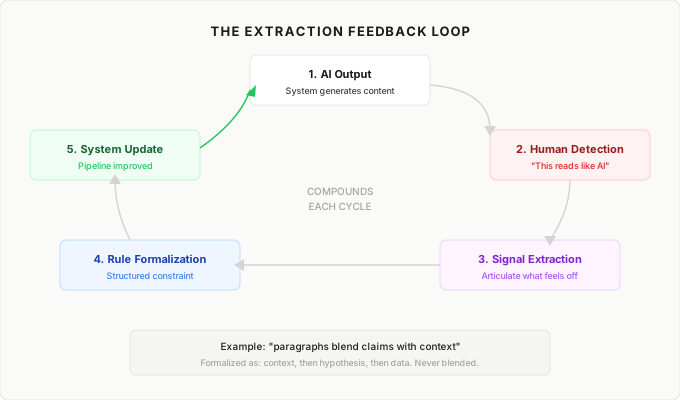
The cycle was concrete:
- Human instinct identified the flaw.
- That instinct was extracted through structured conversation.
- The flaw was translated into an enforceable structural rule.
- The prompt system was updated with the rule as a constraint.
- AI output improved measurably.
- The cycle repeated with the next round of detection.
This is not theoretical. It is documented in the production history of this site. The coordination layer that produced the improvement is exactly the role described in this thesis. AI alone could not resolve the structural issues. A human alone could not formalize the correction into a systematic rule. The bridge between them is what produced the result.
How the Two Roles Interlock
Watch what happens when only one of these roles exists in an organization.
A company deploys a Technical Bridge without an Extraction Layer. The AI systems run smoothly. Agents are coordinated. Drift is managed. Deployments are stable. But the output reads like AI. Marketing materials feel synthetic. Internal reports land with mechanical precision that nobody trusts. Customer-facing communications trigger the same instinct in every reader: "something is off." The systems work. The output does not connect. Adoption stalls not because the tools are broken but because humans do not trust what the tools produce, even when it is technically correct.
A company deploys an Extraction Layer without a Technical Bridge. Someone is capturing human feedback brilliantly. They have documented exactly why certain outputs feel artificial. They have formalized rules for tone, structure, cadence. They have a set of constraints that would make AI output significantly more human. But they cannot implement any of it at scale. The insights exist in a document. The infrastructure to act on them does not. The AI team does not know how to integrate qualitative feedback into system constraints. The rules sit unused while the same structural flaws repeat in every output.
The Technical Bridge manages systems. The Human Extraction Layer manages signal. One handles execution fidelity. One handles human authenticity. Neither produces the full result alone. Together they form a coordination architecture that reduces AI drift, increases adoption trust, translates qualitative nuance into structured logic, and generates the requirement clarity that central AI teams need to actually improve their systems.
The interlock matters because the feedback flows in both directions. The Extraction Layer identifies what needs to change. The Technical Bridge implements the change at scale. The Technical Bridge encounters operational failures that reveal new gaps. The Extraction Layer identifies why users still resist despite the fix. Each role generates information the other needs. Neither can function at full capacity without the other.
This connects to the residual human inputs that The Human Yield identified: taste, direction, judgment, social trust, accountability. The Technical Bridge provides the judgment and accountability layer. The Extraction Layer provides the taste and direction layer. Both are residual human functions that AI cannot perform for itself. They are the coordination architecture that makes the difference between deploying AI and getting value from it.
Business Implementation
Three implementation models are showing up in practice. Each one addresses the coordination gap differently. None of them are theoretical. Companies are running these right now.
Model 1: Embedded cross-functional facilitators. One person per department who speaks both AI and domain. They sit inside the business unit, attend the same meetings, understand the same workflows. They know why the finance team resists automating their reconciliation process (it is not the automation they fear, it is losing the manual check that catches errors nobody else sees). They translate that context to the AI team and translate the AI team's capabilities back to finance. The advantage is deep domain knowledge. The limitation is scale. One facilitator per department does not survive when adoption accelerates across the organization.
Model 2: Central AI services group. A dedicated team that works across all departments, responding to requests. Business units submit needs. The services group triages, implements, and maintains. This is the model OpenAI is betting on. In February 2026, they launched the Frontier Alliances, multi-year partnerships with McKinsey, Bain, Deloitte, PwC, Accenture, and BCG to embed consulting teams inside enterprises as that central coordination layer. The advantage is consistency and infrastructure leverage. The limitation is that central teams lose domain context. They know AI systems. They do not know why the supply chain team's naming conventions matter or why marketing needs the tone to shift between channels.
Model 3: Hybrid technical program managers. People who coordinate AI adoption across the organization without being embedded in any single department or centralized in a services group. They float. They attend meetings across functions. They notice when the same friction pattern shows up in engineering and in marketing and in operations, and they address it systemically rather than solving the same problem three times in three silos. The advantage is pattern recognition across the organization. The limitation is that the role requires someone who can operate at multiple altitudes simultaneously, detail-level in systems and altitude-level in strategy, which is a rare combination.
The progressive, passive, and regressive dynamics described earlier play out differently across these models. Embedded facilitators handle regressive users well because they have the relational trust to address fear directly. Central services groups handle progressive users well because they can match enthusiasm with infrastructure. Hybrid TPMs handle passive users well because they can reduce activation energy across the board. No single model addresses all three user types equally. The most effective deployments run Model 3 as the spine with Model 1 embedded in the highest-friction departments.
The deeper question is whether these roles increase the value of skilled humans or merely delay displacement. JPMorgan Chase deployed orchestrated AI agents and saw loan processing speed increase 40%. The humans in the loop are still there. Their role changed from processing to oversight. Whether that change represents increased value or managed obsolescence depends on whether the coordination skills they are building transfer to the next system or become specific to the current one.
Requirement generation is the leverage point. The Technical Bridge and Human Extraction Layer do not just facilitate adoption. They generate structured requirements that central AI teams could not produce without them. Every friction point surfaced, every instinct formalized, every drift pattern documented becomes an input that improves the next iteration of the system. The humans in these roles are not just consuming AI capability. They are producing the feedback that makes the capability better. That production function is the strongest argument for sustainability.
Strategic Analysis
Seven questions determine whether this coordination layer is structural or transitional. Each one has an answer that does not require optimism or pessimism. Just analysis.
1. Is this a new job category?
Yes. Not in the sense that someone will list "Human Bridge" on LinkedIn tomorrow. In the sense that a structural function exists that was not needed before AI adoption created the coordination gap. The function will be absorbed into existing titles: TPM, AI Program Manager, AI Operations Lead. But the underlying work is new. Managing the space between what AI can do and what humans need it to do did not exist as a coordination problem before 2024.
2. Does it split into two roles or converge?
In large enterprises, it splits. The skill sets are genuinely different. Managing agent drift and sandboxing constraints requires systems thinking. Extracting human signal and formalizing qualitative instinct requires emotional intelligence and domain fluency. One person can hold both, and in smaller organizations they will. But the two functions will professionalize separately as the market matures.
3. Is it scalable?
Scalable with diminishing returns. One bridge per 50-person organization generates outsized value. One bridge per 500 generates clear value. One bridge per 5,000 starts competing with other coordination overhead. The model scales until the coordination layer itself becomes a bureaucracy, which happens to every coordination function eventually.
4. Is it defensible long-term?
The Technical Bridge is moderately defensible. As AI systems improve their own coordination, persistent memory, multi-agent orchestration frameworks, better context management, the gap the Technical Bridge fills shrinks. The Human Extraction Layer is more defensible. It depends on a function AI fundamentally cannot perform: evaluating its own output against human perceptual standards it has not been trained on. You cannot train a system to detect its own artificiality using the same patterns that produce the artificiality.
5. Does it structurally increase human value?
For the specific humans in these roles, yes. They develop coordination skills that compound across AI system generations. They build organizational knowledge that is not automatable because it exists as relational context, knowing why department X resists and what department Y actually needs, not as structured data. For aggregate human value across the economy, no. These roles serve a small number of people relative to the displacement AI creates elsewhere. They are high-value positions, not high-volume positions.
6. Is it transitional until AI internalizes this layer?
Partially. The Technical Bridge is more vulnerable to automation. Better tools will reduce the coordination overhead of managing agent swarms. Persistent context, improved safety frameworks, and native multi-agent orchestration are all active research areas. The Extraction Layer is harder to automate away. It requires AI to evaluate its own output against criteria that emerge from human perception, and human perception shifts as AI output improves. The target moves. The instinct for "this reads like AI" recalibrates as AI gets better, which means the extraction function does not converge to zero. It recalibrates alongside the systems it monitors.
7. What would have to happen for AI to eliminate this coordination role entirely?
AI would need to reliably detect its own structural artificiality and correct it without human feedback. That requires a model that can evaluate its output not against training data patterns, but against a qualitative standard that exists only in human perception and shifts continuously. It is not a matter of scale or compute. It is a matter of the evaluation function itself being external to the system. As long as the benchmark for "does this feel human" lives in humans, the extraction role persists.
The coordination gap is real. The roles filling it are real. The question is not whether they matter now. They demonstrably do. The question is whether they represent a permanent feature of AI-integrated organizations or a transitional phase that better systems will absorb. The honest answer is: both, depending on the role. The Technical Bridge trends toward absorption. The Extraction Layer trends toward persistence. And the organizations that figure out how to deploy both while the gap exists will capture the value that everyone else loses to friction.
AI created the gap. Humans are filling it. Not because they were asked to. Because the system does not work without them.